Posted by BritneyMuller
Are you building links the right way? Or are you still subscribing to outdated practices? Britney Muller clarifies which link building tactics still matter and which are a waste of time (or downright harmful) in today’s episode of Whiteboard Friday.
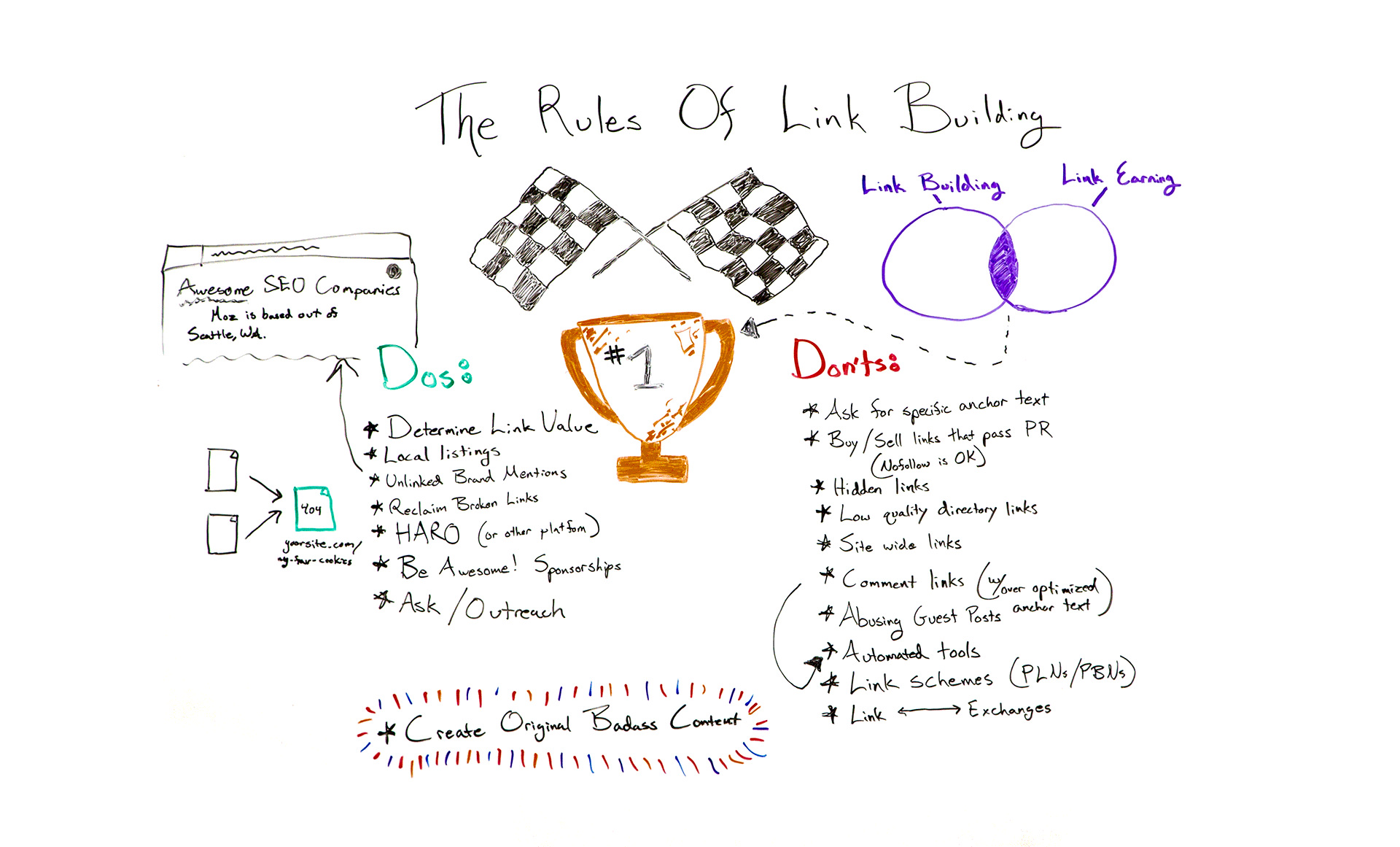
Click on the whiteboard image above to open a high-resolution version in a new tab!
Video Transcription
Happy Friday, Moz fans! Welcome to another edition of Whiteboard Friday. Today we are going over the rules of link building. It’s no secret that links are one of the top three ranking factors in Goggle and can greatly benefit your website. But there is a little confusion around what’s okay to do as far as links and what’s not. So hopefully, this helps clear some of that up.
The Dos
All right. So what are the dos? What do you want to be doing? First and most importantly is just to…
I. Determine the value of that link. So aside from ranking potential, what kind of value will that link bring to your site? Is it potential traffic? Is it relevancy? Is it authority? Just start to weigh out your options and determine what’s really of value for your site.
II. Local listings still do very well. These local business citations are on a bunch of different platforms, and services like Moz Local or Yext can get you up and running a little bit quicker. They tend to show Google that this business is indeed located where it says it is. It has consistent business information — the name, address, phone number, you name it. But something that isn’t really talked about all that often is that some of these local listings never get indexed by Google. If you think about it, Yellowpages.com is probably populating thousands of new listings a day. Why would Google want to index all of those?
So if you’re doing business listings, an age-old thing that local SEOs have been doing for a while is create a page on your site that says where you can find us online. Link to those local listings to help Google get that indexed, and it sort of has this boomerang-like effect on your site. So hope that helps. If that’s confusing, I can clarify down below. Just wanted to include it because I think it’s important.
III. Unlinked brand mentions. One of the easiest ways you can get a link is by figuring out who is mentioning your brand or your company and not linking to it. Let’s say this article publishes about how awesome SEO companies are and they mention Moz, and they don’t link to us. That’s an easy way to reach out and say, “Hey, would you mind adding a link? It would be really helpful.”

IV. Reclaiming broken links is also a really great way to kind of get back some of your links in a short amount of time and little to no effort. What does this mean? This means that you had a link from a site that now your page currently 404s. So they were sending people to your site for a specific page that you’ve since deleted or updated somewhere else. Whatever that might be, you want to make sure that you 301 this broken link on your site so that it pushes the authority elsewhere. Definitely a great thing to do anyway.

V. HARO (Help a Reporter Out). Reporters will notify you of any questions or information they’re seeking for an article via this email service. So not only is it just good general PR, but it’s a great opportunity for you to get a link. I like to think of link building as really good PR anyway. It’s like digital PR. So this just takes it to the next level.
VI. Just be awesome. Be cool. Sponsor awesome things. I guarantee any one of you watching likely has incredible local charities or amazing nonprofits in your space that could use the sponsorship, however big or small that might be. But that also gives you an opportunity to get a link. So something to definitely consider.
VII. Ask/Outreach. There’s nothing wrong with asking. There’s nothing wrong with outreach, especially when done well. I know that link building outreach in general kind of gets a bad rap because the response rate is so painfully low. I think, on average, it’s around 4% to 7%, which is painful. But you can get that higher if you’re a little bit more strategic about it or if you outreach to people you already currently know. There’s a ton of resources available to help you do this better, so definitely check those out. We can link to some of those below.
VIII. COBC (create original badass content). We hear lots of people talk about this. When it comes to link building, it’s like, “Link building is dead. Just create great content and people will naturally link to you. It’s brilliant.” It is brilliant, but I also think that there is something to be said about having a healthy mix. There’s this idea of link building and then link earning. But there’s a really perfect sweet spot in the middle where you really do get the most bang for your buck.

The Don'ts
All right. So what not to do. The don'ts of today’s link building world are…
I. Don’t ask for specific anchor text. All of these things appear so spammy. The late Eric Ward talked about this and was a big advocate for never asking for anchor text. He said websites should be linked to however they see fit. That’s going to look more natural. Google is going to consider it to be more organic, and it will help your site in the long run. So that’s more of a suggestion. These other ones are definitely big no-no’s.
II. Don’t buy or sell links that pass PageRank. You can buy or sell links that have a no-follow attached, which attributes that this is paid-for, whether it be an advertisement or you don’t trust it. So definitely looking into those and understanding how that works.
III. Hidden links. We used to do this back in the day, the ridiculous white link on a white background. They were totally hidden, but crawlers would pick them up. Don’t do that. That’s so old and will not work anymore. Google is getting so much smarter at understanding these things.
IV. Low-quality directory links. Same with low-quality directory links. We remember those where it was just loads and loads of links and text and a random auto insurance link in there. You want to steer clear of those.
V. Site-wide links also look very spammy. Site wide being whether it’s a footer link or a top-level navigation link, you definitely don’t want to go after those. They can appear really, really spammy. Avoid those.
VI. Comment links with over-optimized anchor link text, specifically, you want to avoid. Again, it’s just like any of these others. It looks spammy. It’s not going to help you long term. Again, what’s the value of that overall? So avoid that.
VII. Abusing guest posts. You definitely don’t want to do this. You don’t want to guest post purely just for a link. However, I am still a huge advocate, as I know many others out there are, of guest posting and providing value. Whether there be a link or not, I think there is still a ton of value in guest posting. So don’t get rid of that altogether, but definitely don’t target it for potential link building opportunities.
VIII. Automated tools used to create links on all sorts of websites. ScrapeBox is an infamous one that would create the comment links on all sorts of blogs. You don’t want to do that.
IX. Link schemes, private link networks, and private blog networks. This is where you really get into trouble as well. Google will penalize or de-index you altogether. It looks so, so spammy, and you want to avoid this.
X. Link exchange. This is in the same vein as the link exchanges, where back in the day you used to submit a website to a link exchange and they wouldn’t grant you that link until you also linked to them. Super silly. This stuff does not work anymore, but there are tons of opportunities and quick wins for you to gain links naturally and more authoritatively.
So hopefully, this helps clear up some of the confusion. One question I would love to ask all of you is: To disavow or to not disavow? I have heard back-and-forth conversations on either side on this. Does the disavow file still work? Does it not? What are your thoughts? Please let me know down below in the comments.
Thank you so much for tuning in to this edition of Whiteboard Friday. I will see you all soon. Thanks.
Video transcription by Speechpad.com
Sign up for The Moz Top 10, a semimonthly mailer updating you on the top ten hottest pieces of SEO news, tips, and rad links uncovered by the Moz team. Think of it as your exclusive digest of stuff you don’t have time to hunt down but want to read!
 https://ift.tt/2ujYXB1
via Tumblr https://ift.tt/2ujhbmd
Nhận xét
Đăng nhận xét